Blue J is the only Beneteau First 260 sailboat in North America. This site was originally dedicated to her story, but has since been widened to include topics of interest to any First 260, 25.7, or 25S owner.
Of Sprits, anchors, and Code Zeros
Get link
Facebook
X
Pinterest
Email
Other Apps
-
While modern non-overlapping boats are very versatile, everyone that sails them knows that they suffer reaching in light airs. The smaller jib bas no chance matching the power of a large genoa, and the wind angle is too tight for a spinnaker. A Code 0 is the obvious answer, but that requires a secure tack-point in front of the bow and clear of the bow pulpit. As the 260 had no solution as delivered, several years ago I fabricated a mock-up out of cardboard with a plan to have it made in aluminum.
And while this was workable and would also have allowed for an asym to be tacked there are well, I did not proceed because it complicated another sore-spot with the boat, and that is anchoring. The 260 has no real bow roller, and retrieving a plow anchor with the plumb bow involves a high-wire acrobat's skills holding the anchor clear while pulling in the chain. The sprit would have made it worse. So I waited.
Salvation arrived in the form of a picture on a European-based First260 FB group. An Italian member posted a picture what looked to be a custom 260 sprint, with an integrated anchor roller. I quickly contacted him for details, and he pointed me to the builder in Italy.
The company was Gold Service Rigging, and they have a series of clever designs that allow a custom fit after some simple measurements were provided. As that already had the First 260 numbers, starting the process was as simply as picking materials and ordering. Now on to the sail!
I turned to my go-to sailmaker for this: Somerset sails, and we quickly came up with a build plan.
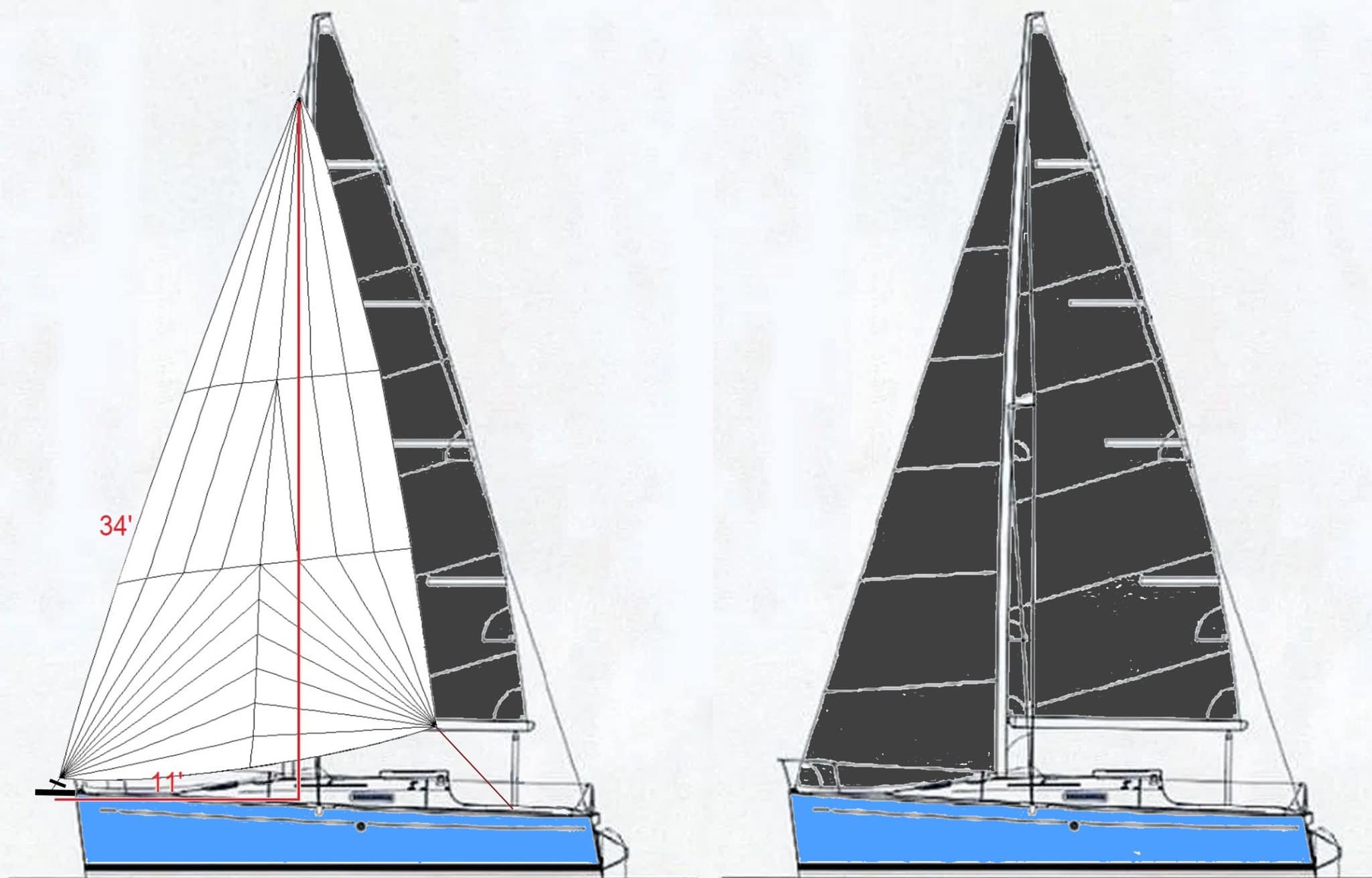
The sail was to be built out of DP CZ laminate, with a high clew to facilitate reaching and allow better furling. You can see how much bigger the CZ is compared to the 105%. If you plan on racing with it, make sure your mid-girth:foot ratio conforms to the RRS and and local requirements for spinnakers. We also agreed on the furler that I would use so we could size the sail, a Ronstan Series 80.
Everything arrived pretty much the week of launch, so we had a couple of busy days. The install of the sprit was amazingly straightforward; most of the time was spent checking the location of hole to drill in the boat! Once done, the sprit is super solid, and looks factory. No regrets!
Flying the asym from the tip of the sprit is easy and powerful, the Code Zero has delivered everything we could have wanted. First is furling ease. It winds perfectly on its anti-torsion line via the Ronstan furler.
And its off-wind performance delivers. In 7 knots true wind, the boat reaches along at an easy 6 knots.
And anchoring a breeze now. When we race, we pull the anchor and chain down and back into the boat and store them in the anchor locker, keeping them away form the flying sails.
Several readers have asked about retractable poles. Indeed we had one on BlueJ for a season or two. And it worked for Asyms, but did not help with the other two problems. Using it on a lake was also complex due to the constant pole management (we rarely sail on a single point of sail for long). But they ARE effective, and a decent solution. I wrote about it at the time, HERE.
I have a after-season full report of the Code Zero performance HERE.
Interesting solution. I always wanted to have a bowsprit in my first 260 but I was thinking to mount the regular telescopical one. Thanks for ypur blog, all about your F260 experience so interesting!
Also a great solution. You may have saw, I had a Sparcraft pole on the boat for awhile. And while it worked great, it was not the best solution for lake sailing, where the constant pole management can become a hassle. And it clutters the foredeck. The final disadvantage that for the very long size of the pole, the effective projection is only 16 inches (40cm). The pole blog entry is here: http://rarerarebird.blogspot.com/2014/01/260-mod-bowsprit.html
Hello Marin. My friend and I actually installed the Unibow ourselves while the boat was in the slip. It took less that 2 hour total, so 4 total man hours? It’s a 2-person job for sure. We taped the line we wanted, and secured the tip (part on the line) with the halyard. Marked and drilled the holes for the aft bolts on both sides, then placed them thru the part and into the holes to hold the Unibow on the taped line. Then we marked and drilled this rest. Then just bolt, seal, and tighten. We probably could have finished in half the time, but we went slow and measured everything very carefully. The job was made easier on the First 260 as the bolt holes are easy to access on the inside of the V berth.
UPDATE: This post is outdated due to the new fixed prod we have placed on BlueJ. This is left for archival purposes. More details on the new prod HERE . To make cruising with the asymmetrical spinnaker easier, we installed a removable, retractable Sparcraft bowsprit on BlueJ. The hardware is first class. The pole mounts to the deck with three hockey-puck shaped discs that the pole mounts clip to. Removing or extending the pole is a matter of moving the brackets. On BlueJ the pole extends about 16 inches. We did not get the pole to add extra J distance on the boat, but only to help the tack clear the bow, and to make gibes easier. It does this very well. Note the adjustable tack line extending through the pole and back to the cockpit. More information on the pole is HERE
If you are an American sailor with international sailing aspirations, you have probably heard of the ICC. Sometimes described incorrectly as an 'International Sailing Licence' or 'Global Charter Certification', its roots and purpose are more complex, and somewhat strange to Americans. I'll start with a little background. More ancient than automobile driving, mariners (in particular recreational mariners) have long enjoyed a tradition of loose or non-existent licencing of their activities world-wide. Even in well developed countries like the USA, there is very little in the way of formal requirements in order to operate a boat. This has led the world to view American charter skippers as 'Credit Card Sailors', due to the only thing needed with their name on it to sail is their credit card! As often happens in matters like this, the ICC got its start in Europe. The close proximity of countries and the mixing of languages, laws, and cultures made a mis...
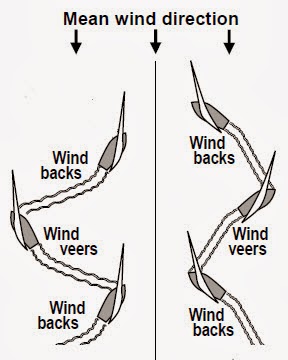
To be successful in windward/leeward racing, a good tactical compass is a must. Without it you cannot read wind shifts, and if you miss shifts you miss sailing on the shorter, lifted tack. The diagram on the right shows it... the boat on the right tacks when knocked, so is sailing lifted after the tack and straighter to the mark. All else being equal, she will be the first boat to the weather mark. So tactical compasses are a big deal. The question is, which one? On BlueJ we have used several units, always mounted to mast below the boom where the whole crew can see them from anywhere on the boat. And we are always looking out for a new edge. Here is what we have learned. NOTE: Much of the device review below is outdated. BlueJ now uses a dual Sailmon MAX mast mounted system, integrated into the boat's NEMA2k network via WiFi. Read more about that system HERE . First up is the Velocitek ProStart. This US$600 device has three functions: 1) GPS-based Speed over gr...


.jpg)


Interesting solution. I always wanted to have a bowsprit in my first 260 but I was thinking to mount the regular telescopical one. Thanks for ypur blog, all about your F260 experience so interesting!
ReplyDeleteAlso a great solution. You may have saw, I had a Sparcraft pole on the boat for awhile. And while it worked great, it was not the best solution for lake sailing, where the constant pole management can become a hassle. And it clutters the foredeck. The final disadvantage that for the very long size of the pole, the effective projection is only 16 inches (40cm). The pole blog entry is here: http://rarerarebird.blogspot.com/2014/01/260-mod-bowsprit.html
DeleteHello, I hope you see this. How many manhours did your boatyard charge you for the Unibow installation? Kind regards- Martin
ReplyDeleteHello Marin. My friend and I actually installed the Unibow ourselves while the boat was in the slip. It took less that 2 hour total, so 4 total man hours? It’s a 2-person job for sure. We taped the line we wanted, and secured the tip (part on the line) with the halyard. Marked and drilled the holes for the aft bolts on both sides, then placed them thru the part and into the holes to hold the Unibow on the taped line. Then we marked and drilled this rest. Then just bolt, seal, and tighten. We probably could have finished in half the time, but we went slow and measured everything very carefully. The job was made easier on the First 260 as the bolt holes are easy to access on the inside of the V berth.
Delete