Posts

A new kite!

Image
In the final act of making sure we were getting 100% of the performance potential from BlueJ, it was time to get a bespoke mid-weight runner made. Prior to this, all of our kites have been hand-me-downs, bought online for around $300. While often without patches or tears, they were usually 20+ years old and soft. I wanted a deep running kite that would hold air. So I reached out to my sail-maker, Somerset Sails. After a short discussion, we agreed on an 0.75oz AirX tri-radial runner, in solid blue. Was going to look like this: While it was being made, we did our training and tune-up races with our old kites. Then one day in our crew FB page, our sailmaker posted this picture, saying it would ship that same day! The UPS page said it would arrive with any luck on Thursday afternoon, right before our race. I tracked it all the way in, and on thursday at noon I happily surprised the crew with this picture: The breeze was forecast in the 8-12 knot range, perfect for breaki...

Full bottom and keel redo

Image
After being in denial about the state of the bottom of BlueJ, I decided this spring to take the plunge and have the whole thing redone. We had done everything else (sails, traveler, rigging, crew) that we could to the boat to make her faster, and we always felt that there was more speed to be had. Be every year, the timing (or the finances!) seemed off, and we just sanded a bit, and splashed some more Micron CSC on her and call it good. This year was going to be different. So in the first week of April, I trucked BlueJ to Marine Fiberglass in the Twin Cities, probably the best place to have race-boat work done on your bottom. The plan was to: Soda blast to bare gelcoat and iron Treat the iron keel with Ospro rust sealant Seal the keel with Interlux Interprotect 200E Fair the keel with thickened 200E Barrier coat the bottom and keel with 200E Paint everything with VC17m The first job was the soda blast, which will remove ALL old paint but not touch the gelcoat. Amazing. I ...

Getting an International Certificate of Competence (ICC) in the USA

Image
If you are an American sailor with international sailing aspirations, you have probably heard of the ICC. Sometimes described incorrectly as an 'International Sailing Licence' or 'Global Charter Certification', its roots and purpose are more complex, and somewhat strange to Americans. I'll start with a little background. More ancient than automobile driving, mariners (in particular recreational mariners) have long enjoyed a tradition of loose or non-existent licencing of their activities world-wide. Even in well developed countries like the USA, there is very little in the way of formal requirements in order to operate a boat. This has led the world to view American charter skippers as 'Credit Card Sailors', due to the only thing needed with their name on it to sail is their credit card! As often happens in matters like this, the ICC got its start in Europe. The close proximity of countries and the mixing of languages, laws, and cultures made a mis...

2016 BlueJ Race Season Recap

Image
2016 has drawn to a close and reflecting on the season, I'm proud of how we sailed this year; even with the turmoil it was a great year and our results reflected it. Most satisfying results-wise is our light-air results; two of our wins came in races in less than 5 knots of breeze, beating an Olympic class Soling both times. As a crew we know we can dominate when the breeze is up but winning in the light air is a sign of us really getting the boat dialed in. BlueJ is clearly not a pure  racer like much or our competition, but we can beat anyone, and do it in style and comfort!  35 races attended 24 races sailed (others abandoned due to weather, lack of wind) 14 podiums (>50% of races sailed) 7 race wins 5 trophies As a sign-off for the racing season, here are some of the photos we got to choose from for our awards trophy. All photo credits to Dallas Johnson. Before making the final choice... An easy call because Jodi drives for t...

Amazing late fall sailing

Image
November can be hit or miss in Minnesota. While we go as often as we can until the water freezes, often it is in winter sailing gear. Not so this year, where all four Shackleton Cup weekends were delightful, and 3 of them were warm enough to wear shorts. One of the warm ones featured an all-girl BlueJ crew. We had a blast, and ate and drank like kings. And queens. Here we are rolling a Santana 2023R under spinnaker in 15 knots. And it was not just the weekends, the next week Wednesday looked great so Dan and I took off a day of work and went sailing. My iPhone thought that was so cool that it made a movie out of the adventure. The last Shackleton was cooler (34F) and VERY foggy at the start. Only three boats ventured over to Maynards for the event. We had to use our compass and nav apps to get our of Wayzata Bay and into the open lake, where the visibility improved. On the way back we drag-raced an S2 7.9 on a tight reach back to Wayzata Bay. We were in a hurry an...

LED Nav/anchor replacement bulb

Image
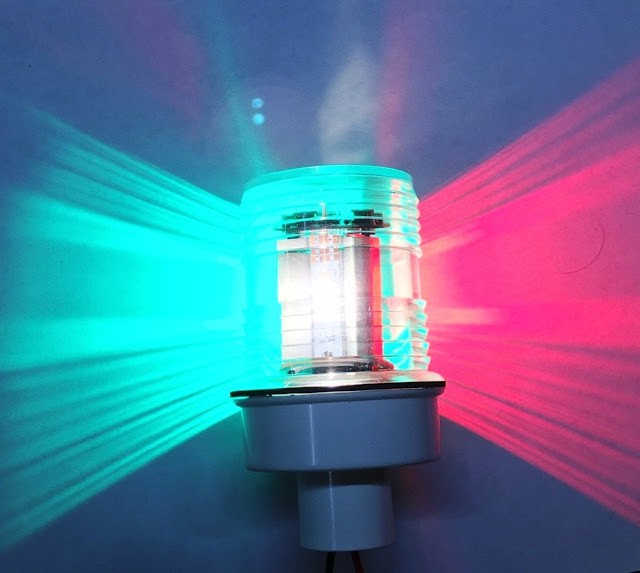
Depending on the build year and the market, the First 260 often came with a single light at the mast top, most typically a red/green/white navigation light. Designed for offshore/coastal use, the fixture placed the light source high where it was easily seen. The single light has its disadvantage however, the primary one being that there is no provision for an anchor light. You CAN replace the fixture to a stacked nav/anchor light, but beyond that being expensive, you still need to run another set of 12v wires to the top of the mast, and add a switch to your DC panel to control it. So most boats stayed rigged in the original manner. A later option was a LED replacement fixture from NASA Marine in the UK. Called the Combi-LED, this light had the innovative ability to be controlled by ONE 12V wire pair, meaning no new wires to be pulled. It did this by reversing polarity to get anchor light, and came with a small switch to add to your panel to control this. I looked at doing this for ...

La Mouette - a Conq/Finot design

Image
Back in 2009, during the height of the worldwide financial crisis, Conq/Finot penned this 27 footer in the image of the First 260. Designed to much of the design brief of the 260, it incorporated a carbon rig, electric auxiliary, and asymmetric kites. Rumor had it that this was a Beneteau proposal that never saw the light of day. While it is not clear if that was true or not, it would have competed with the well selling First 27.7. The resemblance to the 260 is very clear, and even more so to the updated First 25, which moves the mainsheet/traveler to the transom, utilizes a fathead main without a backstay, and has a spreaderless mast. The boat was called La Mouette , which is French for 'seagull'. Roughly translated, the designers words on the boat were: The experiences of the Vendée Globe IMOCA 60 and the adaptation to new energy, recycling of materials and the moderation of the size of the sailing necessities by the crisis, lead us to imagine a concept boat that will ...