Posts

Pit/control line optimzation
Image
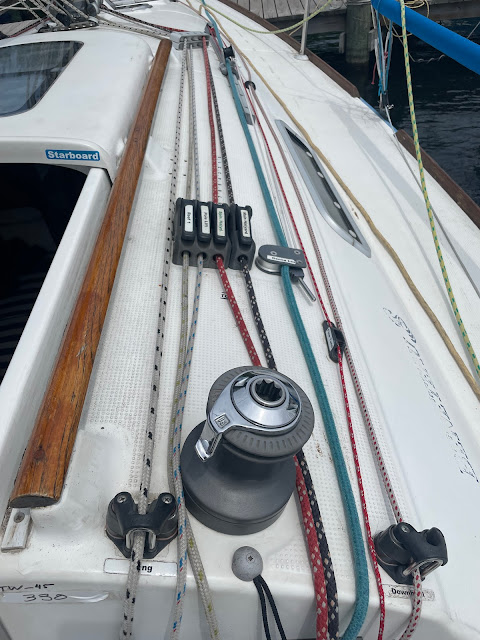
As we race a lot of windward/leeward races, the efficiency of the pit is of primary importance. While generally well thought out in the original design and hardware assortment, there was a number of things I wanted to do to make it better. And as we often sail with asyms, it needs to support that as well. Some of the goals were: Double end key controls (vang, foreguy) so they can be played from either side Increase the purchase for key controls (vang, foreguy, outhaul, cunningham) Run halyards for optimal port windward roundings Create the same pit environment as the First 36.7 (cross-training boat) Bring the cunningham into the pit Double ending the vang and pole down means 4 and not 2 line controllers, as well as deck turns. This means 2 extra clutches and deck organizers, as well as moving the furling line. The starboard side looks like this; from the inside out: Vang Reef Spinnaker topping lift Main Halyard Spin Halyard Genoa sheet Genoa car adjuster Spinnaker for...

New mainsail for 2016

Image
Due to a deal I had with my sailmaker, I took the opportunity to update the mainsail on BlueJ. Cut from the same pattern as our old sail, it is made out of Challenger ZZ19 Twarlon string laminate. Solid black unless light shines through it. it has amazing shape, looks fast, and IS FAST. Great deal. The day for the brake-in sail started out too gusty for a new sail, but by the time we got out it was 10-12; perfect for checking it out. Dan and I had a great sail, and Tonka Paparazzi was out and got the first pictures. Sailing and chilling. Blackness.

Racing 2016

Image
Wow, where has this year gone? BlueJ has had quite a good year racing at WYC, with a long string of  race wins and podiums to our credit. Most impressive for us has been our 2nd place in the Sunset series, which is the premier season-long tally for the Thursday evening races. We have also settled in with racing with a crew of 4 (bow/trim, pit, main, driver), two who are new to the boat and new to racing. The Bay series is more of a fun race for us; with the weeds we cannot avoid or shed, we shuck if its light. And this year every race was. But we still have fun, like drag racing with J-24s downwind. The Fall is coming up, which promises more wind and less weeds. Its our best season.

Downwind race sequence

Image
We get a lot of GoPro video of our racing, but it's rare that we get to see an extended sequence from outside the boat. Our YC photographer comes out to shoot pictures for trophy frames several times a year, and during one race caught us in an entire downwind leg. While working to capture the entire fleet, he happened to be at the windward mark while we rounded, and zoomed down to the leeward in time for us to round there too. We get to pick one of these (others too!) images for our framed photo trophy this year, but the sequence makes for fun viewing. At the windward mark with our nemesis Stinger (USA 96), and a back-marker from the Capri 25 fleet that started 3 minutes before us. We round the mark and drive over to the offset mark while crew readies for a bear-away set. At the offset, a big ease on the main and BlueJ powers up when I drive down to take Stingers transom. We're ready to hoist, and if we are quick we can drive underneath them. We're g...

Of pilots, tamers, and clutches

Image
From day one I knew I would have some manner of self steering on BlueJ. Sailing alone or short handed, the ability to leave the tiller and perform another task was a problem that would need solving. The trick is that there are several good solutions, and the one that is best will be a function of YOUR needs. Looking at the situation, the choice quickly broke down into two discreet camps; devices that will actually 'steer' the boat, and devices that simply hold the tiller. What solution you choose will be based on your needs. In fact, any one of these might be the right solution for you depending on your sailing program. Electronic Tiller Pilots First up is the electronic tiller pilots (ETP), with the Raymarine ST1000+ being a prime example. Using a built-in compass and strong motor, an ETP will actively steer the boat to a heading, moving the tiller to maintain course. Interfaced with the correct electronics, the ST1000+ will also steer to an apparent wind direction, mak...

Fixing leaking ports

Image
You cannot imagine how gratified I am to see this picture. That is one of BlueJ's port windows after a torrential 3 days of rain, and NO LEAKS. Sadly she has been plagued by leaking windows from the day we got her, and my weak attempts to fix them always seemed to leak again. I finally buckled down and addressed the issue full on, and the result is dry cockpit cushions without the use of buckets! The first part of any battle is to know your opponent. In our case, the First 260 uses Lewmar OLD Standard Portlights, Size FOUR. The OLD is important, and so is Size Four. Lewmar produced these ports until 1998, so I assume Beneteau would have switched to the (new) Standard Port sometime after that. According to the Beneteau USA Spare Parts site, the cutoff was at Hull # 352. The key differences is in the latch, which does not penetrate the window, and the frame. More on that later. I discovered that leaks can come from several places, but the primary two reasons are worn or aged r...

Handrail replacment

Image
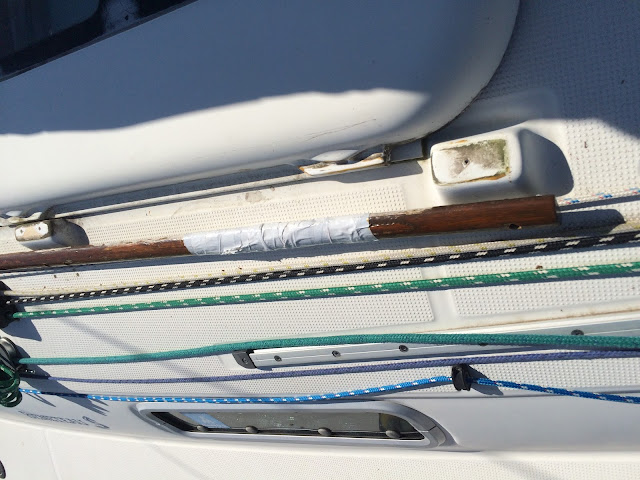
After 15 years of hard use, the starboard cabintop handrail on BlueJ began to crack. Partially because the wood was not properly treated on the bottom, and partially because of crew constantly clambering over the cabin-top to the new windward side. I tried to glue and screw it back together, but in the end it failed again. So I taped it as a stop-gap, and started to look at a new solution. One big issue I have with the construction on the First 260 is the manner in which the rails are attached. Not bolted but screwed into place with 4 SS screws, they could be pulled off under load. I HATE structural screws on sailboats. Happily, as far as I can tell these are the only screws used in the construction of the 260. They just happen to be in an unsafe place. In addition, because of the screws, removing the rails requires pulling off teak caps covering the screws, not an easy job and it damages the rails. It is the reason that a large abandoned mud dauber (a type of non-biting wasp) ne...